Friday, November 9, 2018

Are Remote Robot Games a 'Thing' yet?

In the past 2-3 years there is a convergence of technologies that are enabling the streaming and control of robots through the internet.  However, remote robotic control, for fun purposes like gaming is still in its infancy.  Why is this?  Why is remote reality gaming and robotic gamings still not a 'thing' (yet)?

The Convergence:
Maker based Robot Creation, Home internet broadband capability, low cost of components, converging with YouTube Streaming, Twitch Game Play, as well as the introduction of chatbots, AI, and ML are converging to make the concept of remote robot games a reality.

I would start to differentiate these as webcams on robots, exploring with robots, and games with robots.  The control of the robot could be observational, or first person.

The most basic - watching robot games on TV, like the picture below. This is very basic robo-sport.  It could be interesting, but in the current state is not very engaging.


I think the real interest in being able to engage with the robot from the internet.  Being able to steer it, perform some action, and potentially meet some (game) objective.

Robospatium
The best example of that in a non-commercial setting would have to be at Homofaciens.de. Homofaciens has build an environment (Robospatium) where you can remotely through the internet connect to a rover-robot and steer it around.  These robots have be working for many years, probably one of, or the first of its kind.  In addition to the robot rover, Homofaciens has a wealth of information for physical computing.  Norbert has a very successful YouTube channel with great videos on building your own robots from everyday items.
R11 Rover - Image from Homofaciens.de
Check it out >> the Original!  In English and German
Homofacian's Robospatium  (https://homofaciens.de/robospatium_en.htm)


Let's Robot.TV - https://letsrobot.tv/

letsrobot.tv is the work of Jillian Ogle. She has been featured on the cover of Make Magazine. She is setting out (like the rest of us) to make robots accessible to everyone, fun and enjoyable.  Letsrobot.tv is a platform where you can view and control remotely robots that are created and 'living' in robocaster's locations. 

There is a heathly community of robot enthusiast developing around Letsrobot.tv. Easy instructions are available how to create and add your own robot to the letsrobot.tv platform. In addition to open source code for the development of the robot, runmyrobot, on Github.


The platform supports a chat function allowing you to participate in the control of the robots with others. Having some of the local tokens, you can steer the robots and have them say things.

There are a few varieties of robots available on the platform.  This would include "The Claw" game, where you can remotely operate a claw arcade game and try to grab prizes from with in.

The letsrobot.tv platform is just gearing up now.  It has received a lot of publicity from MAke and the Makers fair.  It is notable that the platform is handling the video streaming quiet well.  This is one of the more important elements of a remote controlled robot.


Twitch Generation
It seems that the natural platform for the streaming of remotely controlled robots would be Twitch.tv.  Twitch is the streaming platform for electronic games where you can watch professionals and amateurs play video games.  Truly a sign of the times, Twitch itself is the convergence of streaming and gaming communities. To add to this, Twitch has added a creative channel that provides a means for artists and craftsman to stream their creations. So, it would be natural for a robot to stream as well - especially an internet controlled robot.  (Twitch is not alone, YouTube also realizes the value in streaming gaming)


TheOtherLoneStart - Twitch Chat controlled robot battles

One Twitch streamer has recognized this next step and created a Twitch chat controller robot, and associated gaming feature.  If you tune into TheOtherLoneStar twitch streaming channel you may find him building robots, or hosting a battle between his robots.  All for fun, you can certainly internet remote control the bots and have fun with them.  He also has videos of the builds, play action, and a HackaDay project.

Remote Games
Finally there is a new style of remote robotic games that have been created by "Remote Games".  Remote Games is a Ukrainian company that is also "living the dream".  They have created a game that allows for up to 10 (20?) special robot explore and compete an a intricately designed set based on a ghost town near Chernobyl. (yes, the site of the nuclear melt down)


Hyper real set from Remote Games - Image from Remote Games

The hyper-real set is amazing!  Here, with a subscription, you can explore the ghost town with a robot tank and compete in real time with others in different game formats.  The game company is planning to offer franchises of their gaming platform for others to operate their own arenas.  I would liken the model to that of 'laser tag' business plan, but with an Internet audience.

Interesting to note, one of the founder stated "we noticed how quickly remote-controlled game robots are gaining popularity". I think that there view point matches many in the maker/robot community.  we are only just now starting to see the new use cases of robots, robot games, and remotely controlled robots.  

I think it will soon become a 'thing'.


Tuesday, October 30, 2018

Mojo2 (#19) - Walking! A Compliant Quadruped Walking Robot Dog

Mojo2 is walking!  Much tuning and tweaking is needed to make this type of robot walk. The Compliant Quadrupeds do not have the same knowledge and control of robots like Boston Dynamic's Spot mini.  However, like Mojo2, can be significantly smaller, and fast compared to the size and length of the robot.

Check out the video and Totally Not Evil Robot Army Channel on YouTube:


You may have noticed new Cams that are larger and have new features that allow for easier adjustment of the cable tension. This is done by tying the cable to a washer, which can be placed on screws that can be repositioned.

The larger cams have a significant impact on the ability to lift the knee and foot when moving the leg forward. A the gait or walk was slowed slightly, which also created a little more stability.

Did you notice the heavy power bank has been moved to the underside of the robot. This lowers the center of gravity and ... increases stability.  Stability is the common theme.

Most important is the gait. The gait is a true Lateral Sequence Walk. this means that for more than 50% of the time, the feet are on the ground.  But lateral sequence allows for two of the legs to be in motion at the same time.  I feel this is a good achievement for a DYI - 3D printed robot.


Mojo2 - October 30th 2018

Monday, October 15, 2018

Mojo2 (#18) - First Successful Walk

Mojo can now walk!

Numerous testing and enhancements including new feet/"paws", stronger 'tibia', and gait positioning have led to the first successful walk.  See the video below.


Leading up to the successful walk, here are the issues that had to be resolved.


Back side of Mojo2 - right hind leg is translationally forced inward.
The new button - switches between 'walk' and 'stand' is very useful!

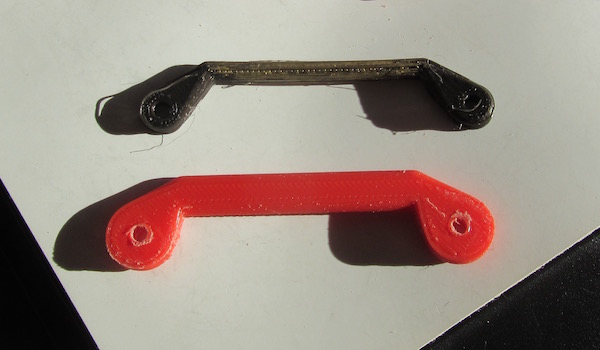
New tibia, stronger with larger hinge
one of the biggest issues was the amount of "translational" movement of the leg.  This means that the leg was able to be bent under the robot very easily by the forces put on it. It is caused by the looseness and flexibility in the leg and its joints.  tightening the screws holding the linkages together helps - but increasing the size of the hinges would help more. In addition, creating a tighter screw hole will decrease this flex.  In the process of doing this, it became evident that the 'tibia' linkages were highly flexible - they twisted quite easily. The fastest fix to this issue was to make the tibia thicker and reprint the linkages.

New Tibia - larger, much less torsional flexibility - same size 70mm
With all (8) new tibia installed, the leg structures are significantly more ridged. this prevent the bending inward as seen in the first part of the video.  you can easily spot the new tibia, since they are now red instead of back. 

New Paws with a more compliant capability
The Paws have been replaced in the latest video sequence. you may notice that the robot is resting on the new compliant, spring loaded, paws.  This should add to the compliancy of the robot as well as provide more traction to the pull of the leg.  However, it is evident in later tests, that the compliant paw requires the leg to lift more in order to clear the ground surface.  This is a problem yet to be addressed.


New Distal "paws" or feet, now compliant with effective springs.
Gait Sequence
The gait sequence is actively being adjusted. In the latest runs, the hind legs have been moved back by 10 degrees.  This new posture has improved the stability, and may have been directly responsible for the first successful steps.  However, there are many many variable in this dynamic problem. Tuning one or two often leads to another instability.

In the process of adjusting the tibias, the SEA on the rear hind leg broke. I printed out new one and used a different spring.  The k-constant value of the springs varies by spring. This creates another uncertainty in the tuning of the legs. Having a reliable means to determine the 'k' of the springs would help in creating a consistent behavior across each leg. An adjustable SEA would do wonders.


Broken connector at top of SEA

Getting it to repeat
To be honest, some minor adjustments after the successful test, have created a newly unstable robot. Tightening some of the joints can result in the robot starting to 'moon walk'. This illustraits how sensitive the robot currently is to small changes. More improvements into tuning and adjustment will be needed to start getting consistent results.  But that is what makes this fun.  Right? :)

Another failure: the eye screw suffered metal fatigue being screwed in to a small hole. This can not be removed, thus requiring a new part to be printed.

Saturday, October 13, 2018

New Agility and Application

The Robots are getting better!  They are getting faster and more agile, this will lead to new applications and use cases.  On the 'agile' front new videos are out from Boston Dynamics showing their current Atlas robot doing Parkour!


The dynamics of self-stabilization and location awareness are magnitudes better than just a few years ago when we saw videos of robots stumbling in the woods, gravel, and uneven surfaces.  The magic here is in the controllers that are able to identify the right amounts of force to to apply to surfaces, the right of amount of energy in the actuators, and the enhanced SLAM (Simultaneous localization and mapping)

Can it get more bizarre?  Yes it can!

Meet Salto a small jumping robot from UC Berkeley's Biomimetic Millisystems Lab. Salto is a mono-ped, just one leg. It has inertial stabilization with a swing arm as well as small "quadcopter" motor/blades for pitch and yaw control. Last year we were amazed to see Salto jumping and exploring.  This year, they have had dramatic improvements to the controller enabling more precise hopping to obtain an objective like climbing on a table.


The exploring robots are coming.  They are sprinting, hopping, and learning.

Another good example of the enhancements in SLAM (remember: Simultaneous localization and mapping?) is the MicroMouse challenge.  In this challenge small robotic "mice" are programmed to autonomously search a maze to find the "cheese".  After the exploration phase, the mouse returns to home and runs the maze for speed.  Here is an example of the ability to localize, map, and solve - then make a speed run!


These advancements are increabley in couraging. Access to open technologies, microcontrollers, low cost sensors and actuators, etc, are creating a new revolution in robotics. This will create more abilities, new use cases, and new applications. Remote Exploration is a great new use case.  We have been sending probes and robots into space for some time, with new interest and ability in robotics we will be able to explore much further and in much more detail.  A great example of this is the recent MASCOT and  Hayabusa2 exploration of the Ryugu asteroid. This is fantastic robotic exploration work by JAXA and DLR the Japanese and German space agencies.

There is a whole new domain emerging for robots  ... and the Totally Not Evil Robot Army, is getting ready for it!

Mojo2 - 12 Oct 2018 - A Compliant Quadruped Walking Robot Dog


Wednesday, October 10, 2018

Mojo2 (#17) - Walking Trials Continue

The walking trials of Mojo 2.0 are continuing...

It was evident that the lack of balance of the robot was due to the starting leg positions being too far back, creating a tilt forward from the lack of support for the center of gravity.  This could be addressed by changing the starting angles forward.  


Stability could also be increase by elongating the robot.  Luckily, the mojo2 design provides for just that capability. A spacer of 35 mm was added to the waist of the robot.


New "longer" Mojo2


with the new longer version, it was possible to start it walking.  During the trials, the robot fell over on it's side and broke a "hip".  This part was known to be an issue as it was printed with a clogged 3D printer nozzle.  Luckily, it only required 45 min to print a new hip, and about 15 min to replace it.


Broken Hip

once back together the gait examination continued...  it became clear that Mojo2 was walking backwards - because it was programmed too!  :0

The coding has be reworked and the servos reconfigured.  Mojo is soon to be walking forward, I will have video in the near future. paw stability is now the biggest issue.  more to come!


Mojo 2.0 - A Compliant Quadruped Walking Robot "Dog"