Showing posts with label ASV-USV. Show all posts

Wednesday, February 19, 2025

Minone - Introduction of my MVP Robot for SLAM Exploration

Exploring Robots are cool. Robots that map their surroundings? Even cooler. But there’s a massive difference between slapping together a chassis and motors and actually building a robot that can autonomously explore and create a map of its environment. That’s the problem I’m setting out to tackle with Minone, my MVP (Minimum Viable Prototype) for an exploration-focused robot.

Minone - MVP for SLAM

Why Start Simple?

Most SLAM (Simultaneous Localization and Mapping) discussions dive straight into complex sensor suites—LiDAR, stereo cameras, high-end IMUs—but I’m deliberately taking the opposite approach. Instead of relying on fancy hardware, Minone is built to push the limits of simple sensors, starting with nothing more than an ultrasonic distance sensor (HC-SR04).

Why? Because understanding SLAM at its core—filtering noisy sensor data, estimating position, and reconstructing an environment—is much more valuable than just plugging in a high-end sensor and hoping for magic. I want to see how much useful data I can extract from the bare minimum before moving on to more advanced solutions.

A Scrap Yard Robot

In true MVP fashion, I built Minone from whatever I had lying around:

  • Chassis: The top of an old wine box. (Recycling counts as engineering, right?)
  • Motors: Two Roomba drive motors salvaged from an old unit.
  • Caster Wheel: From a trashed suitcase. (Turns out, old luggage makes for decent robot parts.)

It’s the ultimate scrap yard robot, which makes it easy to modify as I iterate. That’s already proving useful, since I’m starting to regret my choice of a trailing caster wheel—turning is fine, but the bot has a tendency to tip forward. A problem for Future Me to solve.

Electronics & Control

For brains and motion control, I’m using:

  • Microcontroller: ESP-32S
  • Motor Driver: L298N H-Bridge

This will be my first time working with an ESP-32S, so I’m looking forward to seeing how it handles real-time sensor inputs and motor control. The L298N should manage the Roomba motors' voltage needs just fine (in theory, at least).

The Underpowered Sensor Challenge

The HC-SR04 ultrasonic sensor is laughably weak for proper SLAM. It’s low-resolution, has a narrow field of view, and struggles with certain surfaces. But that’s exactly why I’m using it—I want to figure out how to make the most of bad data.

If I can extract meaningful spatial information from this absolute potato of a sensor, then adding better sensors later (IR, TOF, LiDAR) will only make the system stronger.

What’s Next?

With the basic hardware in place, the next steps will be:

  1. Getting Minone moving – Setting up basic motor control with the ESP-32S and L298N.
  2. Reading sensor data – Making sure the HC-SR04 is providing usable distance measurements.
  3. Starting simple SLAM tests – Even basic dead reckoning will be a good first step.

As I build and test, I’ll be refining Minone’s design—possibly rethinking that caster wheel before it faceplants one too many times.

Stay tuned for the next update! 🚀

Tuesday, April 5, 2022

Autonomous Boat: Mayflower

IBM / ProMare - Mayflower 400 ASV

[UPDATE 28.04.2022 - The Mayflower 400 ASV appears to have started a journey across the Atlantic]

IBM and ProMare have teamed up with to create an autonomous boat that is capable of ocean crossing. This, of course, has been already accomplished. This is the next iteration in the development of this technology, and a great way to see how IBM solves this problem

in 2021 the boat attempted to cross from Plymouth, UK to Plymouth, USA. Unfortunately, this attempt had to be aborted due to a mechanical issue (the output exhaust connector failed, which lead to exhaust inside the cabin, eventually affecting the generators efficiency.  stuff happens!).

The boat will attempt the crossing again in the Spring 2022. It is even possible now to connect to the boat to observe the sea-trials. A dashboard has the telemetry from the boat as well as a video feed.

Links


Live view from Mayflower

Video can be found on the Dashboard as well as on IBM's streaming site

ProMare is a not for profit that is "Promoting Marine Research and Exploration". They also have interesting projects such as Ultradeep UAVs and ROVs

[update:  You can find the Mayflower400 ASV at any time using vesselfinder.com]

Thursday, March 17, 2022

Trans-ocean-robots: Autonomous Surface Vehicles


ASV - Autonomous Surface Vehicles  OR 
USV - Uncrewed Surface Vehicles (link goes to Wikipedia)

no matter what you call it... they are the Robots of the Sea! 

It is an excited aspect of robots. Here is some recent news in the realm of marine robotics...

Make Magazine has a nice write up on a group of Makers the had an interest in building a sailing robot to cross the Atlantic Ocean.  Their hopes and dreams lead to projects, hometown support, and eventually - a robotics business. 

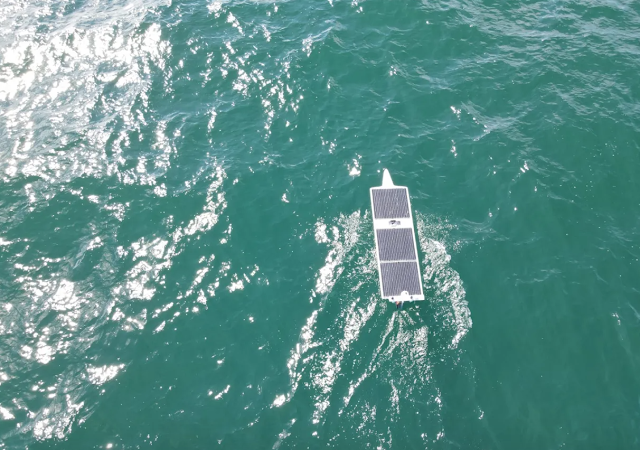
Scout - Transatlantic (Make Magazine)

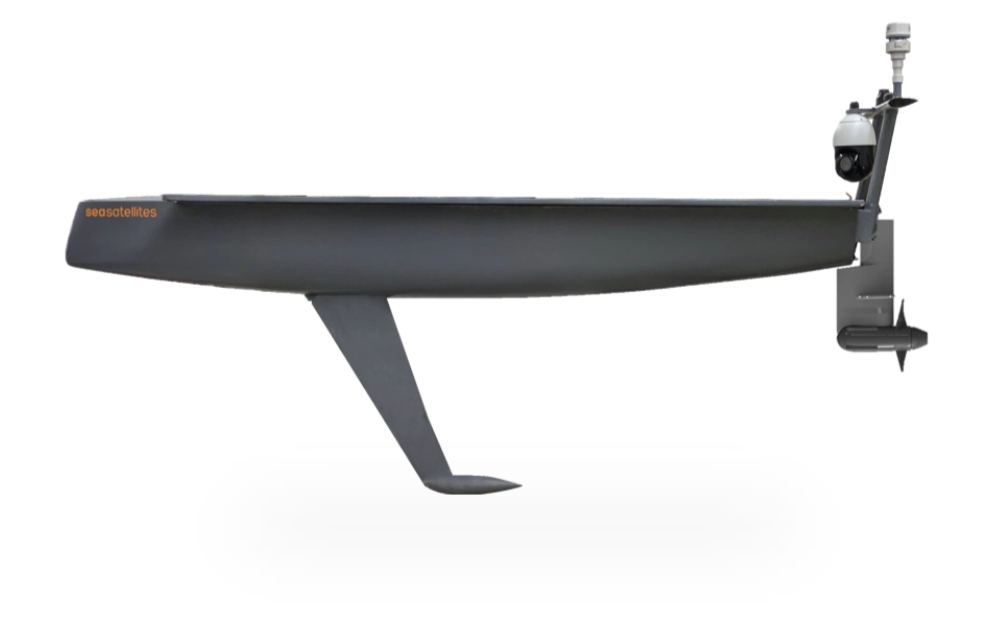
From the article, you see that they have formed a robotics startup in San Diego named Seasats.  seasats (https://seasats.com/)

seasats - X3 robot


good luck to them!  I can add them to my list of other startups in the same space. In fact, It has been about 18 months since my original post on offshore robotics companies.  How are they all doing now?

Ladon Robotics - formerly the Ladon Project, might be getting off the shore again. They recently received a Innovation grant from the NSF for autonomous cargo delivery.  Keep an eye out for updates.


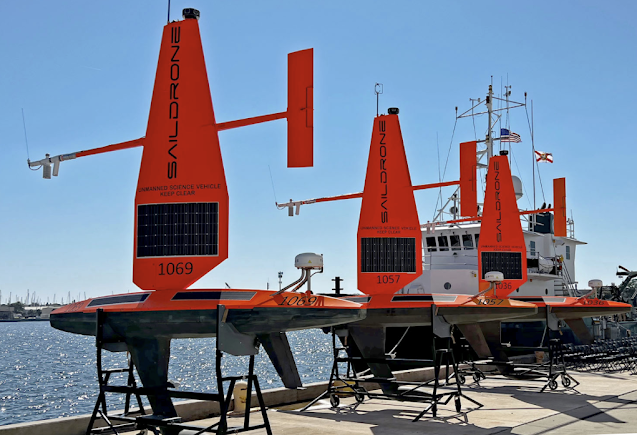
SailDrone - Well, they are a BIG thing now.  have a read of their current mapping HQ.

Ok, this is officially an industry!  These guys SailDrone didn't exist a few years ago. now they have huge contracts with NOAA and the State of Florida.  Their drones are about $500k apeace! 

well that takes us to...

Liquid Robotics (a Boeing Company). They too are growing, and performed a large survey for Japan.

Offshore Sensing - seem to still be making business. Their website has great information, but does not have much upto date on missions.  They do seem to have many international sales offices.  As an example, while in spain, this site came up on their website: Grafinita.

Teledyne Marine - The makers of the most impressive underwater low energy vechiles the Slocum Glider. Now has a page for Teledyne Autonomous Surface Vehicles. It looks like this side of their business is not quite as fully developed (as the slocum) but at least in the Market. Interesting, maybe they are just a little too large for this specific innovation. 

smaller companies like:

Seafloor Systems - Specializing in Hydrographic Survey Solutions

Rest of the World:

so, where are their European counterparts?  who is selling to the UK, Ireland, France, Spain, etc.... (!)  Are the Japanese doing this? what about the south China sea?

Ocean Alpha - Hong Kong

YSI - Hycat - 

ecomarinepower - has an ASV. They are a Japanese based company.

Norway:

Maritime Robotics - has a number of solutions.  The Mariner (offshore), The Otter (sheltered waters)

In the totally not evil (military) categories...

Utek - from Spain, mostly USV.  And mostly having a big machine gun mounted on a zodiac. Totally, Not Evil...

L3Harris - with the their C-Worker 5 ASV, it is one of a fleet of ASV. Also with great navigation software.

Market:  according to a market analysis report the market players for USV from 2020:  note, most of these are fro Military applications. (Totally Not Evil...)

  • Kongsberg
  • Teledyne Technologies (Teledyne Marine)
  • ECA Group
  • Elbit Systems Ltd.
  • Textron Systems
  • ASV Global - acquired by L3Harris
  • Atlas Elektronik
  • Rafael Advanced Defense Systems
  • Liquid Robotics

of course this is missing the ones mentioned above, such as Sail Drone and Seasats.

And where did Dan McMillon, from my original post the guy that built the robot that naviated from California to Hawaii, and on to New Zealand, endup?  looks like his own (happy) startup. ;) Blue Trail Engineering. Engineering advice and products for Marine Robotics. Way to go Dan!

And for submersibles, this is still super awesome Hydromea.  Ah, swiss innovation... truly robotics leaders in their own rights.  I just wish I had the backing of an institution like ETH Zurich!


That is all for now, stay posted for more updates in the USV / ASV robotics world!