Showing posts with label DARPA. Show all posts

Tuesday, April 14, 2020

Mojo3 - A Robotic Dog (#7) - OK, One More Test!

Mojo3 is a Compliant Quadruped Robot Dog

Ok, maybe I should read my own blog posts. I believe I was supposed to do a new design. Instead I started the Milli - th WildWorm, but that is a different post.  Before I jump off to a new design, maybe just ONE MORE TEST?  I build the hip servo mechanism so that now we can see the actual distance traveled by the robot's leg.


Mojo3 - Leg Design with Gear Driven Hip and Bearing
The new hip design will be just a gear driven leg unit, and a gear on the servo - as the CAD picture suggests. This design should work, as the weight of the servo is now directly transferred to the Chassis through the bearing. This should remove the considerable load from the small 9g servos.

Mojo3 - Kinematic Motion Test

Here the test is set up, the leg is moving repeated through a single step. There is a 60 degree sweep of the hip section, and a 40 degree pull on the leg segment.  The results are (blurry) below.  In this configuration, the leg is only able to lift about 4mm on the return swing. (I will include the video in the future on my YouTube channel)

Mojo3 - Step Kinematic Motion Trace - Just Not Enough!

Only a 4mm lift on the return of the leg to the forward position.  I do not believe this is going to be enough to overcome the dynamic (tilting) nature of the gate.  Time to consider another design!

on the up side.  A shout out to Oracid1 on YouTube and his nice Inverse Kinematics Arduino code. It is a bit cleaner solution than the one I wrote for Mojo2. I have adopted some of the 'clean code' concepts for Mojo3.

Wednesday, January 8, 2020

Robot Roundup - End of 2019

This is not a end of the decade summary of robotic progress, although, in the last ten years robotics has seen very positive and dramatic growth!  

Perhaps, there is more of a thought of that robots are becoming more mainstream. The thoughts of having self driving cars (which are just big commercial robots) has become more of an inevitability. Just as the chances of seeing robotic characters in a Star Wars (or any space themed) movie.

To me, mainstream will be when you see robots actively working in daily life. Walking around London over the Christmas break, I did not see very many (any) robots, so there is still some time before they are truly mainstream.

In the meanwhile, here are some interesting developments I have personally noted:  (and I am not talking about drones now, they tend not to be autonomous, and in some cases can be somewhat evil.)

Inspection Robots:
Ah, the world of Inspection robotics, probably the most applicable use cases for today's robot technology.

Gecko Robotics - Recently raised $40M USD in series B round of investment.
Gecko Robotics - Pipe Inspection robot
Gecko is now in an expansion phase. They are growing in staff in the 100 person company, with a focus on inspection experts that can interpret the data.  Their business model is to lease out the robots assuming as a service. They currently have 60 robots, and are now looking to expand to 100.

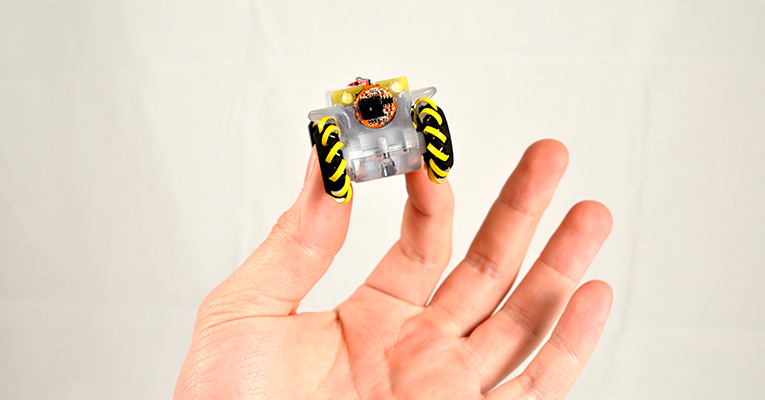
Honeybee Robotics is another robotics company with inspection robots. They have been in business since 1983 and active in Space, Defence, Medical, and Oil/Gas industries. From the website, it seems that they have been very instrumental (pun?) in working with space exploration robotics, specifically the mars rovers. Most recently, the Phoenix drilling robot probe. For inspection robotics, they do not seem to have as much to offer, but you have the love the cute little (tiny) pipe crawling camera platforms.


Honeybee robotics magnetic Mecanum wheel technology

Honeybee Robotics camera pipe inspector
The pipe inspection robot is adorable, but I am not sure how well those wheels will be able to pull a cable load. The metal chassis does look very rugged. Inuktun Robotics - now part of Eddify is the maker of the Versitrax track system for inspection robotics. I have written about Inuktun in the past, as they have a very modular systems approach to their robotics.  Their track system is most impressive in shape and duty cycle.  (I am sure it has a nice price tag to go with it ;) the versitrax system was the inspiration for my design of the Wild Weasel.


Versatrax by Inuktun, now part of Eddify

Versitrax modular track by - Inuktun


GE Inspection Robotics - probably the market leader? I don't know for sure. But, I do know that GE is a top player in any industry the participate in. As a leader in power systems, they would have a strong need to provide inspection robotics for pipelines, boilers, crackers, etc.  The Inspection Robotics division is HQ in Zurich. They seemed to have acquired a number of robotics and software companies and are working to incorporate their technologies together. This is very typical of a large industrial player that can grow by acquiring innovative tech capabilities. (I am not knocking on the engineers that made these fine technologies!)
The Bike platform is one of their compact inspectors with strong magnetic wheels and mobilies technologies. It can drive/cross over a 90 degree corner!


GE Inspection Robotics - Bike Platform

Robot business opportunity, eh?  On a little more along the lines of small business, there are many small companies that will custom build inspection (and tactical) robots for you.  Here is one I recently found, that is located in the US state of North Carolina.
SuperDroid Robots  They specialize in their own custom built robots. Prices range from a few thousand USD to tens of thousands USD.  Check out their site, they have a lot of unique builds and many custom "fun" robots.


SuperDroid "RealCow Robotic System" - probably their most absurd robot (cowbot?)
I highly recommend checking out the site, everytime I go their, I find new robots that they have built. They are quickly becoming a favorite site, even as they have a tendency toward 'tactical'  ;)

speaking of tactical robots for warfighters...

DARPA's grand subterranean challenge - DARPAs grand challenge seems to be moving long.  They have recently completed stage 2 of the challenge.


DARPAs SubT Tunnel Challenge

Here is a great article by Popular Mechanics about the results of the DARPA Subterranean Challenge and the man-made Tunnel Circuit.  I think the impact of this will either be on the receiving end of lidar options, or it could spurn additional research in the Lidar/SLAM aspects of robotic development.  If you read the article, keep an eye out for the "robot with robots", this is one of my favorite themes for future robot explorations!

On the Software side of Robots
There have been a lot of improvements to software systems that will operate and control the robots of the future.  Many of these are open projects, that provide tools for 'the rest of us' to use in our hobbies and businesses.  Some of the most basic, are tools like the Robot Operating System (ROS) and simulators such as Gazebo. I would like to focus a little more on one aspect that will be required for Autonomous robots - Computer visions.  Specifially Computer vision that will be used for simultaneous localization and mapping (SLAM)

OpenCV is leading the way for computer vision with many libraries and easy to use.
openMVG uses multiple images and views to perform photogramy, or constructing the 3D space from graphical images.

With the strong focus by the industry on self driving cars there will be significant enhancements in lidar technology. This should lead to reduced cost for the sensors, and perhaps the processing being moved to a chip to provide direct sensor measurements to the robots SLAM routines.

Ambarella - Computer Vision on a chip, has a new robotics platform and partnership with Amazon. they started their business with video processing chips, but pivoted to providing CV on a chip. This is similar to the open source project of OpenCV (?).  At any rate, this is the types of innovations that will be coming in the next years. Many of the open AI type processing necessary for robotics will be moving to fast implementations on a chip.  (you can also think of this similar to GPUs being broken out from code to a chip).
they will need to work on their messaging a bit, their website states:  
Our intelligent video devices use face detection, analytics, and multi-object CNN classification to enhance security in businesses and homes, without the need for the cloud.
This might be contrary to the interest of their new partner, Amazon.  And a final note about Ambarella, as concerns over our society becoming more and more a surveillance state, this example from their advertising could be interpreted in poor taste:
Is surveillance becoming the new norm?


So, What (else) to Watch in 2020?

Will Amazon have any success in aligning their robotic offerings with these many disparate companies which do their own processing. 

As Boston Dynamics goes comercial, will there be a 'trough of disillusionment' (from the Gartner Hype Cycle) as it applies to robotic dog platforms?  It is a remote observation platform, that can walk in all weather and surfaces. but with remote observation and (limited?) manipulation. Or will we find new use cases that make it a viable, value added, platform.
Boston Dynamics - An Android and his Dog

As an obvious result of the Spot Mini, we have seen many new quadruped robots. All of these knock-offs (and I mean that in a good way) seem to have exact same capabilities and servo placements etc. It is my hope that we quickly move on from this and start to see some truly innovative approaches to robotics, after all they do not have to look like dogs or humans. They just need to be able to perform. This is evident in BDs third robot, Handle, that looks nothing like a human or dog. This robot is built entirely for function, it seems without any thought of form. If anything it looks like a very awkward bird, ok now I am doing the anima-morphing.

Boston Dynamics - Handle

Future?
So, What Would Elon Musk Do? (#WWEMD?)  How would you build your robot business?

Actually, I would not be surprised to hear that SpaceX is thinking about roving robotics. After all, the Falcon 9 is a robot ship (?).  But most of all Space exploration is going to require A LOT of new autonomous robots.

Sunday, December 15, 2019

Mojo3 - A Robotic Dog (#6) - Alternative leg design

A change in thought, a change in name.  Perhaps "A Compliant Quadruped Robotic Dog" is a little redundant and fabricated(?)  To start, "Quadruped Dog" is redundant, Dog implies four legs.  And with today's post, I am missing some compliancy, so let's just go by robot dog.  Perhaps even then, dog is a euphemism, afterall it is just a four legged robot.  ;)

The difficult part is the legs of course.  The first leg has compliancy, but it struggling to meet the additional design criteria of using 9g servo motors.  The engineering challenge of this exercise is to be able to lift the leg enough to move the leg forward, while at the same time absorbing some of the energy of the motion (inferred here as compliant).

While on holiday, away from my CAD, I was imaging what types of other motion that could be used.  For robots here are 5bar mechanisms, and strandbeest mechanisms, servos at the knees and legs (static motion, no compliance), as well as the 'fancy spot-mini' designs with simulated compliancy. Ultimately, there are only 2 degrees of freedom for the appropriate foot motion, so there seems to always be the need for 2 servos. It is just the question of where the servos will be positioned on the robot.

One solution is to assign all of the leg (forward, backward) motion to the hip - one degree of freedom. Then the function of lifting the foot is the sole responsibility of the second motion - the other degree of freedom. after mentally arranging the location of the motion and trying to avoid direct load of the weight of the robot on the servo, I settle on this option for the design.

In this design iteration, the for-leg/foot is directly connected to the top of the leg. There is a pivot point half-way through the for-leg. The foreleg is controlled by two linkages, this allows for the retraction and extension of the foreleg. Now the options for the servo can be either in one of the linkages or a force from the pivot between the linkages. The simpler will be on the linkage itself.

Mojo3 - Alternative leg designs
The question with this design is 'where to put the compliancy'? since the servo is directly connected to the linkages, this puts load on the servo (albeit less load). I think at this stage in the design, I will determine compliance later, mostly likely in the foot of the leg.

Using a the technique of "Frankenstein Prototyping" (a form of rapid prototyping), I mashed up parts left over from the last design as well as disassembling a leg of 'The Bug'.


Mojo3 - leg in down position
Here the leg is extended in the Down Position.  The engineering question will be how much load is placed on the servo in this position.  It would be very desirable to find a mechanism that will 'lock the leg' during the time the hip servo will be moving it backward in motion.


Mojo3 - leg in up position
In the retracted position in the foot is lifted up, allowing for the hip to move the leg forward to the starting position of the gait.

Next Steps:
Answer the engineering question of how the leg will hold the load of the robot.
This can be done by physical testing, by wiring up the servo to the microcontroller and test the motion. If that is successful, then it will be back to the CAD and draft up a new leg based on this concept.  

Friday, August 17, 2018

DARPA - Subterranean Challenge

Earlier this year DARPA (Defence Advanced Research Projects Agency) announced the next Robotics Challenge. This challenge will be underground! They are looking for robots to be capable of exploring and mapping underground structures.  The challenge will have three subdomains: Man made tunnel systems, Urban Underground, and Natural Cave Networks.


The previous Robot Challenges included the original grand challenge of self navigating robots and more recently general robots for human activities.  NASA also recently completed a Robotics Challenge, and will have a new one starting later this year.  NASA Space Robotics Challenge 2

Both DARPA and NASA will have a track that allows for Virtual competition.  The simulation platform of choice is Gazebo part of the Open Source Robotics Foundation managers of the Robot Operating System ROS.

It is natural to think of the use cases and value an underground mapping robot capability could provide.  The recent search and rescue of the 12 boys in Thailand come to mind. Also, many science fiction movies show the future tech of a cave mapping robot, such as seen in the movie Prometheus.

It will be interesting to see the innovation that is spurred from these competitions.  Perhaps they will could find value in a Totally Not Evil Robot Army!